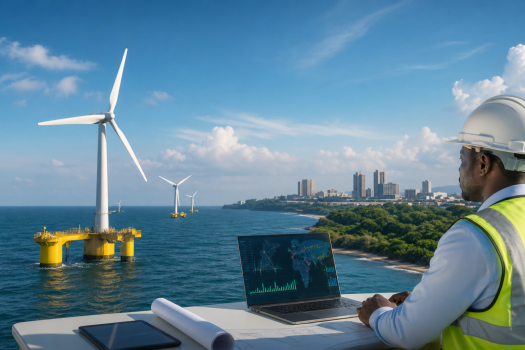
Imagine a coastal university wanting to power part of its campus with more clean energy. The first instinct would be to look for the most visible technology: solar panels, turbines, batteries, perhaps even offshore wind turbines.
But very quickly, the real question changes. It is not enough to produce electricity. It is necessary to connect, maintain, finance, protect the environment, train teams, and engage with communities. Floating wind energy, which has just taken a step forward in the Mediterranean, perfectly illustrates this transition from an appealing idea to a managed project.
What is it, concretely?
A conventional offshore wind turbine is fixed to the seabed, like a post firmly planted. Floating wind energy, on the other hand, rests on a platform that floats and is kept in place by anchoring cables. This solution allows for going further offshore, in deeper waters, where winds can be more consistent. The main challenge is not just the turbine: it also requires suitable ports, underwater cables, offshore maintenance, grid connection, and clear environmental regulations. So nothing magical, but a serious technology that is well understood if viewed as an infrastructure project.
Concrete case: what to do and what not to do
Questions to Ask Before Acting
Do we have reliable local data on wind, sea, the electrical grid, and ports?
Does the project address a specific need: access to electricity, cost reduction, energy security, or decarbonization?
Who finances the investment, maintenance, connection, insurance, and risks?
What skills need to be trained locally even before launching a call for tenders?
Have fishermen, local residents, maritime authorities, and environmental stakeholders been consulted?
Is floating wind actually better, here and now, than a mix of solar, battery, hydropower, biomass, or energy efficiency?
Does the AI used help compare and explain, or does it claim to decide in place of experts?

 UNIVGA Press








 French
  English