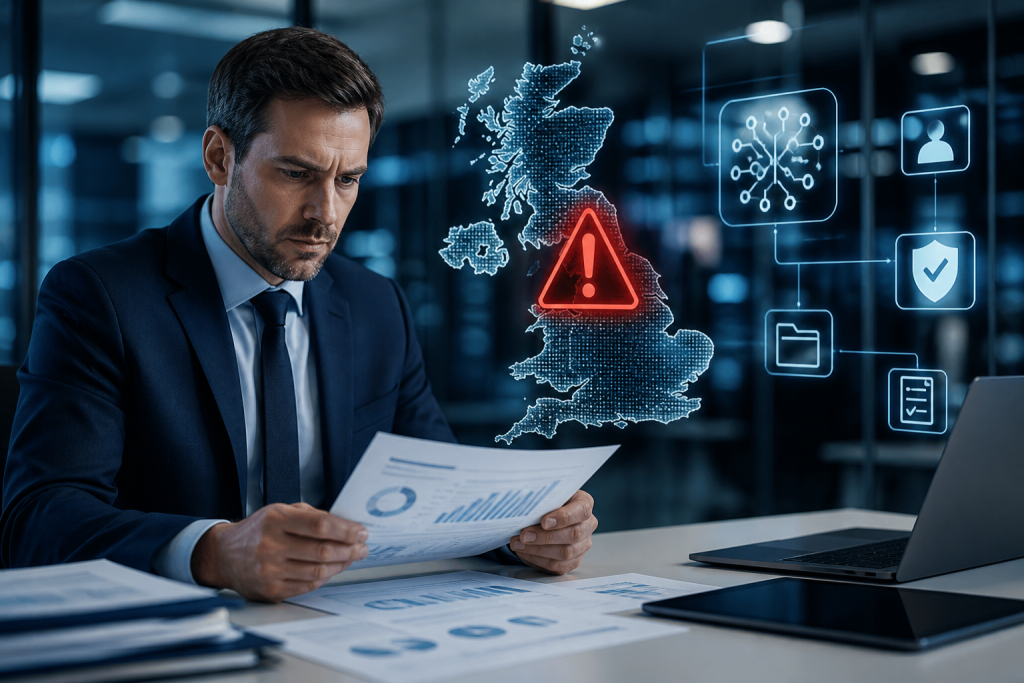
Imagine a university launching an artificial intelligence (AI) platform to manage registrations, student cards, and certain administrative services. Passwords are strong, software is monitored, backups exist. Yet, in the technical building, a maintenance door sometimes remains open to facilitate the passage of service providers.
The risk does not only come from a hacker behind a screen. It can come from an active badge, an unaccompanied visitor, an accessible server rack, or a fire starting in a poorly controlled room. For guarding professionals, the message is clear: protecting the digital realm also starts on the ground.
Recent articles

Offshore: Oxy and Valaris awarded, HSE AI must remain human
MOL solar and battery branch, the cost remains to be proven
Sustainable wood: AFi promotes traceability towards proof
 Certificate
Professional Certificate in Guarding and Private Security
What is it, concretely?
A data center, or center of data, is a building that houses servers responsible for storing and processing information: student records, payments, medical images, business data, or public services. With the rise of AI, these places become even more sensitive, as they run essential tools on a daily basis. We often talk about IT protection, but the mechanism is simple: if a person physically enters the room, unplugs equipment, steals a disk, or uses the badge of a former employee, the incident can become as serious as an online attack. The good news: clear procedures, trained agents, and regular checks significantly reduce the risk.
Concrete case: what to do and what not to do
Questions to Ask Before Acting
- Who has physical access to servers, network racks, and electrical panels?
- Are the badges of former employees, interns, and service providers deactivated quickly?
- Do agents know what to do if a door remains open, if an alarm sounds, or if a service provider insists on entering?
- Do the cameras only film the areas necessary for security?
- Are the images accessed only by authorized personnel?
- Is there a written plan in case of intrusion, fire, power failure, or sabotage?
- Has the legal or compliance department validated the collection and storage of images?
UNIVGA Viewpoint
Sources
- TechRadar Pro, “We’re building the most critical infrastructure of our lifetimes. We’re leaving the front door unlocked”
- Security Industry Association, “AI in Data Center Physical Security: Questions to Ask Technology Providers”
- Office of Management and Budget (OMB) / White House, “M-25-03 Implementation Guidance for the Federal Data Center Enhancement Act”
- Congress.gov, Federal Data Center Enhancement Act, S.933
- Cornell Legal Information Institute, Data Center Validated End User (VEU) Authorization Guidelines
- APDPVP Gabon, texts and laws on the protection of personal data


 French
  English